
Two Control Statements
The if Statement
The Java if statement works much like the IF statement in any other language. Further, it is syntactically identical to the if statements in C, C++, and C#. Its simplest form is shown here:

Here, condition is a Boolean expression. If condition is true, then the statement is executed. If condition is false, then the statement is bypassed. Here is an example:
 In this case, if num contains a value that is less than 100, the conditional expression is true, and println( ) will execute. If num contains a value greater than or equal to 100, then the println( ) method is bypassed.
As you will see in Chapter 4, Java defines a full complement of relational operators which may be used in a conditional expression. Here are a few:

Notice that the test for equality is the double equal sign.
Here is a program that illustrates the if statement:
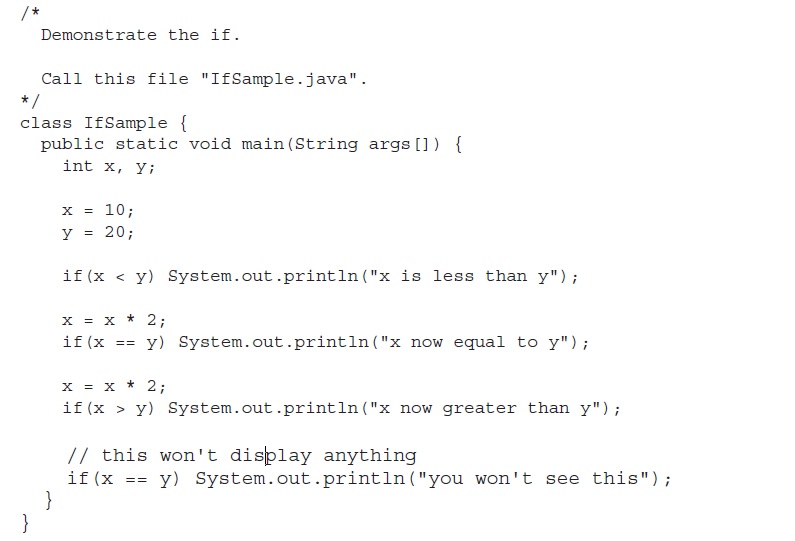
The output generated by this program is shown here:
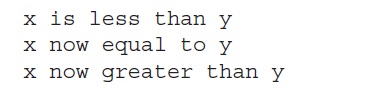
Notice one other thing in this program. The line

declares two variables, x and y, by use of a comma-separated list.
The for Loop
As you may know from your previous programming experience, loop statements are an important part of nearly any programming language. Java is no exception. In fact, as you will see in Chapter 5, Java supplies a powerful assortment of loop constructs. Perhaps the most versatile is the for loop. The simplest form of the for loop is shown here:

In its most common form, the initialization portion of the loop sets a loop control variable to an initial value. The condition is a Boolean expression that tests the loop control variable. If the outcome of that test is true, the for loop continues to iterate. If it is false, the loop terminates. The iteration expression determines how the loop control variable is changed each time the loop iterates. Here is a short program that illustrates the for loop:
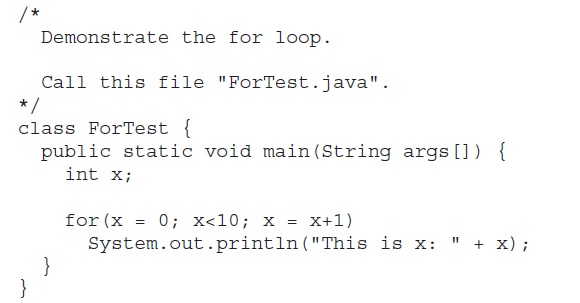
This program generates the following output:
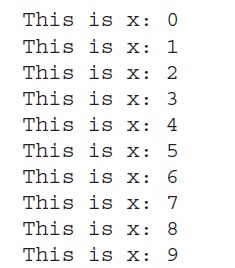
In this example, x is the loop control variable. It is initialized to zero in the initialization portion of the for. At the start of each iteration (including the first one), the conditional test x < 10 is performed. If the outcome of this test is true, the println( ) statement is executed, and then the iteration portion of the loop is executed. This process continues until the conditional test is false.
As a point of interest, in professionally written Java programs you will almost never see the iteration portion of the loop written as shown in the preceding program. That is, you will seldom see statements like this:
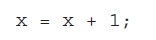
The reason is that Java includes a special increment operator which performs this operation more efficiently. The increment operator is ++. (That is, two plus signs back to back.) The increment operator increases its operand by one. By use of the increment operator, the preceding statement can be written like this:

Thus, the for in the preceding program will usually be written like this:

You might want to try this. As you will see, the loop still runs exactly the same as it did before.
Java also provides a decrement operator, which is specified as – –. This operator decreases its operand by one.